
Blog
Wardrobe Designs in Nigeria 2026 — 12 Styles, Materials, Sizes & Prices
Wardrobe design in Nigeria comes down to three choices made in order: how the doors open, how the wardrobe meets the room, and what the front is finished in. Twelve styles cover almost everything built or sold here — from the hinged two-door that fills most rental bedrooms to the walk-in dressing room in a new-build master suite. This guide sets the twelve side by side, with the room each one actually suits.
Style is the part of a wardrobe decision people enjoy and the part that matters least to whether the wardrobe works. A mirrored sliding front is the right design in a narrow Lagos bedroom and the wrong one in a room where the wardrobe faces a window and will throw glare across the bed. Every style below is judged on the room it belongs in, not on how it photographs.
12 Wardrobe Design Styles for Nigerian Bedrooms
1. Hinged Two-Door
The baseline Nigerian wardrobe. Two doors on visible or concealed hinges, 90–120 cm wide. Gives full access to the opening and is the cheapest to repair. Needs 70 cm of clear floor in front, which rules it out of narrow rooms.
2. Hinged Four-Door
The shared-master-bedroom standard, 180–220 cm wide, usually with a two-door hanging bay and a two-door shelf bay. The most storage per naira of any freestanding design, provided the room can take the door swing.
3. Sliding Two-Panel
Doors that run on a track instead of swinging out. The answer when there is less than 70 cm between the wardrobe and the bed. The trade-off is permanent: you can only ever see half the wardrobe at once.
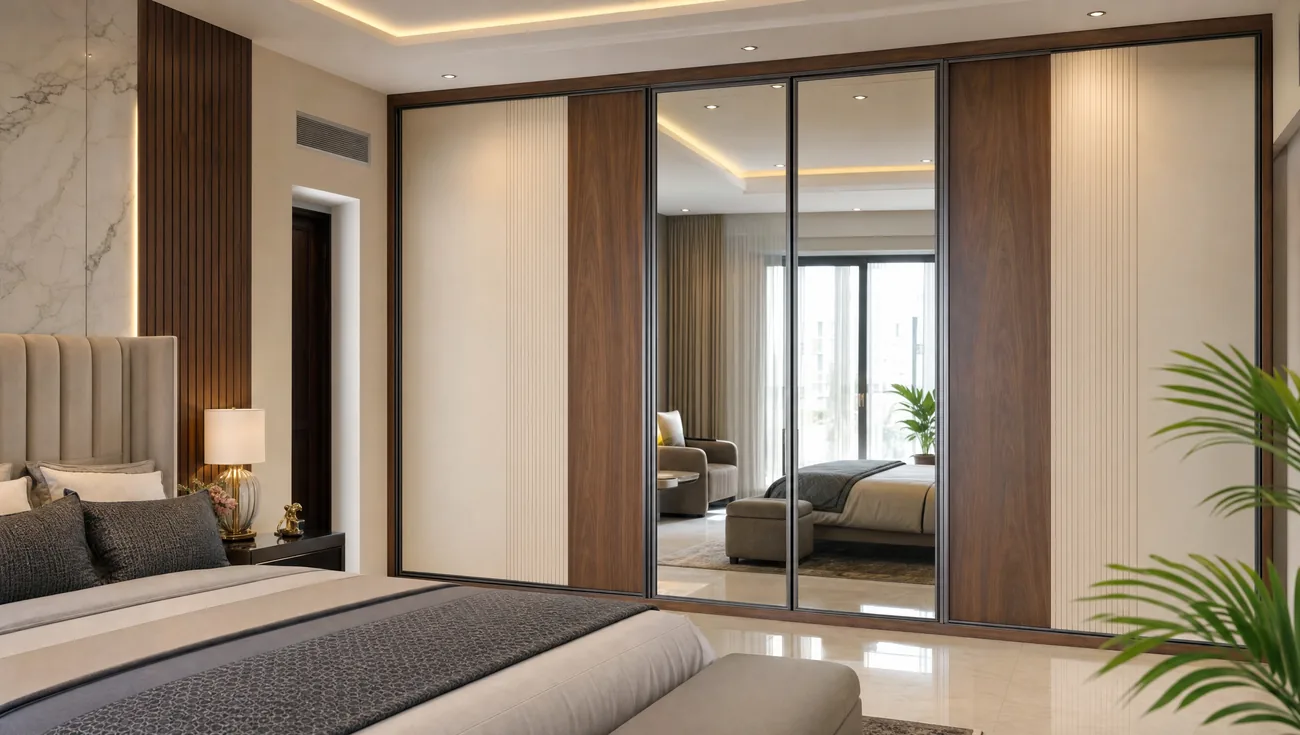
4. Mirrored Sliding
One or both sliding panels faced in mirror. Does two jobs in a small room — removes the need for a separate standing mirror and visually doubles the space. Avoid on a wall facing a window, where it will bounce morning sun onto the bed.
5. Fitted Full-Wall
Built wall-to-wall and floor-to-ceiling, so there is no dust gap above and no dead corner beside. Uses the room’s full height, which is where the extra capacity comes from. Permanent — it stays with the property.
6. Walk-In
A dressing room rather than a wardrobe: open hanging rails and shelving on two or three walls of a small adjoining room. Needs a room to give up, which in practice means a new build or a three-bedroom flat used by two people.
7. Open / Wardrobe Rail
Hanging rails and shelves with no doors. Cheapest by a distance and increasingly chosen deliberately in modern interiors. In Nigerian conditions it means clothes collect dust, so it suits rooms that are cleaned often and wardrobes that are used daily.
8. High-Gloss Acrylic
A mirror-smooth lacquered or acrylic front, usually in white, grey or a deep tone. Reflects light like a mirror without being one. Shows every fingerprint and every scratch, and scratches cannot be polished out — a poor match for children’s rooms.
9. Panelled / Shaker
A framed front with a recessed centre panel. Reads as traditional and hides minor door misalignment far better than a flat front, which is a practical advantage in a humid climate where doors move.
10. Wood-Grain Laminate
A flat front in an oak, walnut or teak-effect finish. The most forgiving design in daily use — grain hides marks that show instantly on gloss or plain white. The default choice for family bedrooms.
11. Corner / L-Shaped
Wraps a room corner, turning the least usable part of a bedroom into hanging space. Worth specifying in an awkwardly shaped room; the internal corner itself is always partly dead space, so expect less capacity than the footprint suggests.
12. Wardrobe With Dresser Bay
A hanging section with an integrated dressing table and mirror in the same run. Saves the floor space a separate dresser would take, which is why it appears in most Nigerian bedroom sets above the entry level.
Wardrobe, Closet or Walk-In: What the Terms Mean Here
The three words are used loosely in Nigerian listings and they are not interchangeable, and the confusion costs money when you are comparing quotes from a showroom against quotes from a carpenter — our roundup of furniture stores in Lagos covers what to expect from each type of seller. A wardrobe is a piece of furniture — freestanding or fitted — with doors, standing against a wall. A closet in Nigerian usage almost always means a fitted, built-in wardrobe rather than the American sense of a small storage room. A walk-in is a room you enter, with open storage on the walls and no doors on the storage itself.
The distinction matters when you are comparing quotes, because a “closet” quote is usually for permanent joinery installed on site, while a “wardrobe” quote may be for a unit delivered assembled. Those are different products with different lifespans, different aftercare and different answers to the question of what happens when you move out.
Door Styles and What They Cost You in Space
How the doors open constrains everything else, and it is decided by the floor clearance in front of the wardrobe rather than by taste.
| Door style | Floor clearance needed | Access | Best in |
|---|---|---|---|
| Hinged | 70 cm+ | Full opening visible at once | Rooms with space at the foot of the bed |
| Sliding | None | Half the opening at a time | Narrow rooms, wardrobe beside the bed |
| Bi-fold | 35–40 cm | Most of the opening | Middle ground; more moving parts to fail |
| Open / no door | None | Everything, always | Frequently cleaned rooms, dressing areas |
Sliding doors carry a real cost beyond price: you lose the ability to see the whole wardrobe at once, which makes deep shelving harder to use. If the room can take hinged doors, hinged doors are the better design. For what each configuration costs, our wardrobe price guide for Nigeria breaks it down by door count and construction.
Colours and Finishes That Work in Nigerian Bedrooms
Three finishes dominate Nigerian bedrooms, and each fails in a specific way. Plain white looks clean and makes a small room feel larger, but shows every handprint around the door edge — it needs a handle, not a push-catch. High-gloss anything reflects light beautifully and scratches permanently. Wood-grain laminate is the most forgiving and the reason it remains the most-sold finish here.
Handles, pulls and internal fittings are the details that date a wardrobe fastest, and they are the cheapest thing to change later — our accessories range covers the finishing pieces that complete a bedroom.
On colour: a wardrobe that runs the full wall should usually match or sit close to the wall colour, because a dark full-wall unit against a light wall reads as a block and shortens the room. A freestanding wardrobe can afford to contrast, since it is read as furniture rather than architecture. Deep tones — charcoal, forest, walnut — work in rooms with good natural light and close in badly in rooms without it.
Interior Layout: What Actually Goes Where
The inside is where a wardrobe is won or lost, and it is the part most quotes gloss over. A standard hanging bay assumes full-length clothes; in practice most Nigerian wardrobes are better split.
- Double-hang for shirts and trousers. Two rails stacked in one bay doubles capacity for anything shorter than a full-length dress. Most wardrobes waste half the height of at least one bay by not doing this.
- One full-height bay only. Reserve a single bay for dresses, agbada and coats. Full-height hanging across the whole wardrobe is the most common capacity mistake.
- Shelves at eye level, drawers below waist. Folded items you use daily belong between shoulder and hip. Drawers below waist height are easy to reach into; drawers above it are not.
- Top 30 cm is long-term storage. Above roughly 210 cm you need a stool. Plan that space for suitcases and out-of-season items rather than daily clothes.
Wardrobe Design Trends in Nigeria for 2026
Four shifts are visible in 2026 specifications. Handleless fronts with routed grip channels or push-catches have moved from high-end into mid-range joinery. Internal LED lighting has become close to standard on fitted work rather than an upgrade, largely because wardrobes usually sit on the wall furthest from the window. Matt and textured finishes are displacing high-gloss, which dominated the previous few years and dates a room quickly. And full-height fitted units are increasingly specified over 210 cm freestanding pieces, because the dust gap above a freestanding wardrobe is a maintenance annoyance nobody wants.
What has not shifted is the popularity of the hinged four-door in wood-grain laminate. Trend coverage over-indexes on walk-ins and gloss acrylic; the wardrobe most Nigerian bedrooms actually get is still a four-door in a wood finish.
Matching the Wardrobe to the Rest of the Bedroom
Specify the wardrobe against the bed, not against a mood board. The bed fixes the room’s remaining wall space and its dominant tone, and the wardrobe has to work with what is left — our guide to bed frame designs in Nigeria covers the sizes that drive that.
The reliable approach is to match finish family rather than exact colour. A walnut wardrobe with a walnut bed in a different grain reads as deliberate; a walnut wardrobe with an almost-walnut bed reads as a mistake. Where an exact match is not achievable, a clear contrast is safer than a near-miss. This is the main practical argument for buying the bedroom as a coordinated set: the matching is already resolved.
Browse Bedroom Sets Request a Quote
Frequently Asked Questions
Which wardrobe design is best for a Nigerian bedroom?
For most Nigerian bedrooms, a hinged four-door wardrobe in a wood-grain laminate finish. It gives the most storage per naira, the grain hides everyday marks that show instantly on gloss or white, and hinged doors let you see the whole interior at once. Switch to sliding doors only if there is less than 70 cm of clear floor in front of the wardrobe.
What are the different types of wardrobe designs?
Twelve styles cover the Nigerian market: hinged two-door and four-door, sliding two-panel, mirrored sliding, fitted full-wall, walk-in, open rail, high-gloss acrylic, panelled or Shaker, wood-grain laminate, corner or L-shaped, and wardrobe with an integrated dresser bay. They differ in how the doors open, how the unit meets the room, and how the front is finished.
Are sliding or hinged wardrobe doors better?
Hinged doors are better wherever the room allows them, because they show the whole opening at once and are cheaper to repair. They need about 70 cm of clear floor to swing into. Sliding doors need no clearance at all, which makes them the only workable option when the wardrobe sits close to the bed — but you can only see half the wardrobe at a time.
What is the difference between a wardrobe, a closet and a walk-in?
A wardrobe is a piece of furniture with doors, freestanding or fitted against a wall. In Nigerian usage a closet almost always means a built-in, fitted wardrobe rather than a small storage room. A walk-in is a room you enter, with open rails and shelving on the walls and no doors on the storage itself. The three are quoted differently and have different lifespans.
Which wardrobe colour works best in a small bedroom?
Light finishes — white, pale grey or light oak — keep a small room feeling open, and a mirrored sliding panel effectively doubles the perceived space. If the wardrobe runs the full wall, match it close to the wall colour so it reads as architecture rather than a block. Avoid mirrored fronts on a wall that faces the window, where they throw glare onto the bed.
How should the inside of a wardrobe be laid out?
Double-hang shirts and trousers on stacked rails in most bays, and reserve just one bay at full height for dresses, agbada and coats. Put shelves between shoulder and hip height for daily folded items, drawers below waist height, and treat the top 30 cm as long-term suitcase storage. Full-height hanging across every bay is the most common capacity mistake.
What are the wardrobe design trends in Nigeria for 2026?
Four trends stand out in 2026: handleless fronts with routed grip channels or push-catches moving into mid-range joinery, internal LED lighting becoming standard on fitted work, matt and textured finishes displacing high-gloss, and full-height fitted units replacing 210 cm freestanding pieces to remove the dust gap above. The most-bought wardrobe is still a hinged four-door in wood grain.
Is a mirrored wardrobe a good idea in Nigeria?
Usually yes in a small or narrow bedroom — it removes the need for a separate standing mirror and makes the room read larger. The exception is a wardrobe on a wall facing the window, where the mirror will reflect morning sun directly onto the bed. Mirrored sliding panels also need their tracks kept clear of dust, or the doors start to drag.
Should the wardrobe match the bed frame?
Match the finish family rather than the exact colour. A walnut wardrobe with a walnut bed in a different grain reads as deliberate; an almost-matching pair reads as a mistake. Where an exact match is not possible, a clear contrast is the safer choice. Buying the bedroom as a coordinated set resolves the matching for you.
Does Vento sell standalone wardrobes?
No. Vento does not sell wardrobes as standalone units and there is no wardrobe category on our site. Wardrobes are specified within our coordinated bedroom sets, which start at ₦2,370,340 and include the bed frame, bedsides and dressing-table options finished to match. If you need only a wardrobe, our wardrobe price guide covers the market bands to look in.