
Blog
Wardrobe Price Guide for Nigerian Bedrooms (2026)
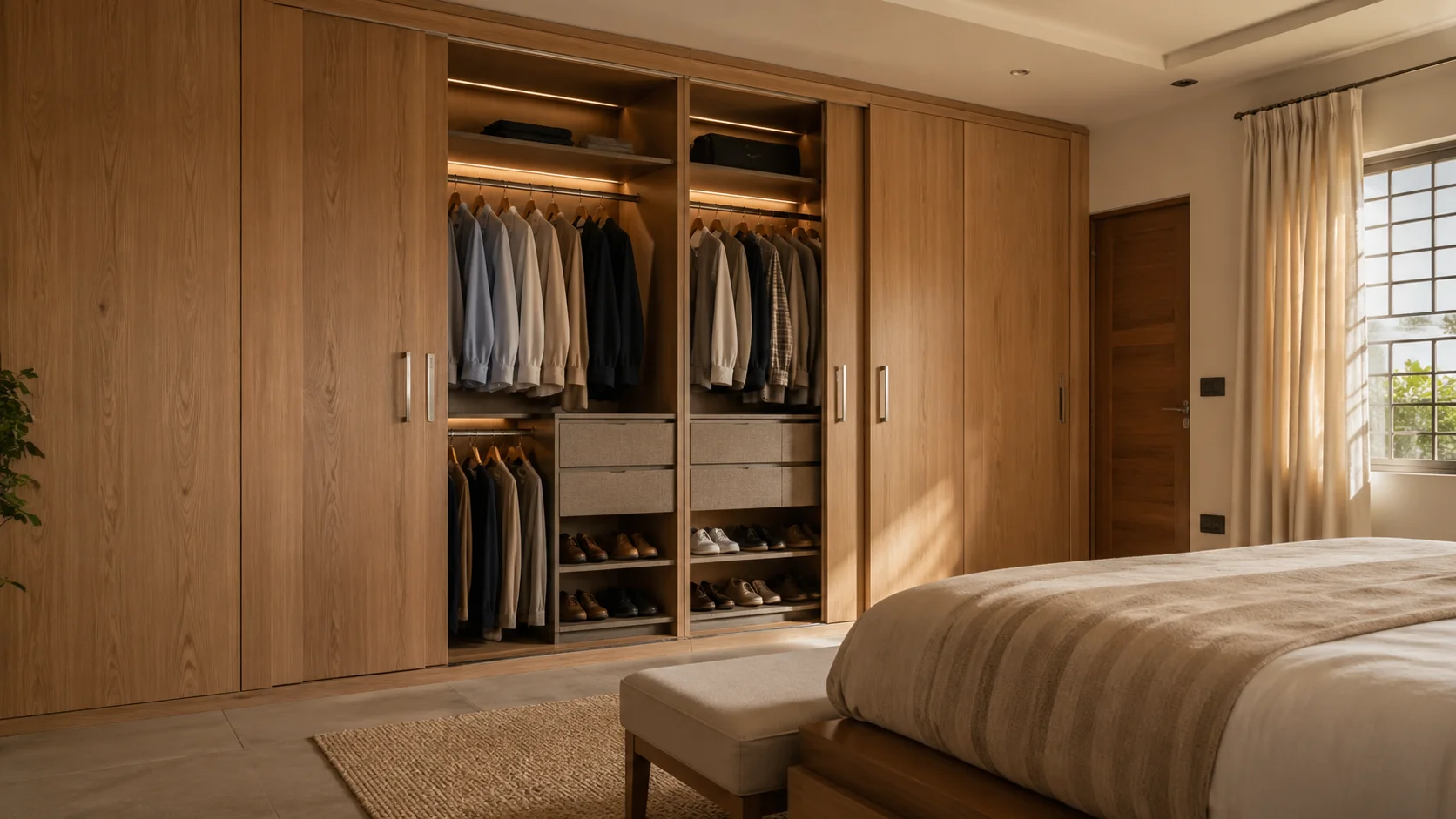
A wardrobe in Nigeria costs anywhere from ₦20,000 for a fabric unit to ₦3,500,000 and beyond for a fitted walk-in closet — the widest price spread of any bedroom item. The number that applies to you depends on three things in this order: whether you rent or own, how many doors you need, and whether the wardrobe is freestanding or built into the wall. This guide gives the 2026 price bands for each route, the hardware costs most quotes leave out, and the questions to ask before you pay a deposit.
Quick Summary
- Fabric or foldable: ₦20,000–₦50,000 — students, short lets, temporary rooms
- Standalone two-door: ₦130,000–₦300,000 for mid-range; under ₦130,000 is usually particleboard
- Standalone three-door or four-door: ₦250,000–₦600,000 in plywood-and-MDF
- Premium showroom standalone: ₦450,000–₦900,000, imported board and branded hardware
- Built-in, full wall: ₦450,000–₦1,200,000 mid-range; ₦1,400,000–₦3,500,000+ for high-gloss acrylic and walk-in
- Budget separately: soft-close hinges ₦40,000–₦90,000, mirrored panel ₦80,000–₦180,000, internal LED ₦70,000
These are market ranges across the Nigerian trade, not one retailer’s list. Where Vento’s own pricing sits is set out further down — briefly, we do not sell standalone wardrobes; ours are specified within a bedroom set.
Rent or Own: The Decision That Sets Your Budget
Almost every wardrobe mistake in Nigeria traces back to skipping this question. A built-in wardrobe is a permanent improvement to a property. If you are renting, you are paying ₦1.4 million to improve someone else’s asset, and you cannot take it with you when the tenancy ends. If you own, the built-in is usually the better value per cubic metre of storage and adds to the property.
The practical rule most Lagos and Abuja tenants land on: rent for under three years, buy standalone. Rent long-term with a landlord willing to share the cost, or own outright, consider built-in. There is a middle route that gets overlooked — a high-quality standalone four-door that moves with you and holds resale value far better than a fitted unit you must abandon.
Wardrobe Prices by Door Count
Door count is how wardrobes are actually quoted and searched for in Nigeria, and it maps roughly onto hanging capacity. Two doors hold one person’s clothes comfortably; four doors are the usual specification for a shared master bedroom.
| Configuration | Typical width | Market price | Suits |
|---|---|---|---|
| Two-door standalone | 90–120 cm | ₦130,000 – ₦300,000 | Single occupant, children’s room, guest room |
| Three-door standalone | 135–160 cm | ₦250,000 – ₦450,000 | One adult with a full wardrobe, or a shared second room |
| Four-door standalone | 180–220 cm | ₦400,000 – ₦600,000 | Shared master bedroom |
| Premium standalone (any door count) | varies | ₦450,000 – ₦900,000 | Imported board, branded hinges, showroom finish |
| Built-in, full wall | 240 cm+ | ₦450,000 – ₦1,200,000 | Owners, long tenancies |
| Walk-in / high-gloss acrylic | whole room or wall | ₦1,400,000 – ₦3,500,000+ | Master suites, new builds |
Sliding doors add roughly 15–25% over hinged doors at the same width, because the track and rollers carry the door weight. They earn that premium in a room where a hinged door would swing into the bed — below about 70 cm of clearance in front of the wardrobe, sliding is the only workable answer.
What Quotes Leave Out
The headline figure in a carpenter’s or showroom quote often covers the carcass and doors only. Four items are commonly separate, and together they can add 30% to the total.
- Hinges and runners — ₦40,000 to ₦90,000. The single highest-value upgrade in a Nigerian wardrobe. Humidity and daily use make doors sag, and branded soft-close hinges are what prevent misalignment in the first two years. Ask which brand is quoted, not just “soft-close”.
- Mirrored panel — ₦80,000 to ₦180,000. A full-length mirror on a door face. Worth it in a room too small for a separate standing mirror.
- Internal lighting — around ₦70,000. LED profile strips inside the hanging section. Genuinely useful in Nigerian bedrooms where the wardrobe often sits on the wall furthest from the window.
- Delivery, assembly and levelling. Frequently excluded from carpenter quotes. A wardrobe that is not levelled on an uneven floor will not close squarely, and that is a callback you will be paying for.
Sizing a Wardrobe to a Nigerian Bedroom
Most Nigerian apartment master bedrooms run between 3.0 × 3.6 m and 3.6 × 4.2 m, and are built around a 6×6 bed. That leaves one usable wall for a wardrobe after the bed, the door swing and the window are accounted for.
Standard wardrobe depth is 60 cm, which is what a hanger needs to sit square. Anything shallower forces clothes to hang at an angle and creases shoulders. Height is usually 210–240 cm; the top 30 cm is out of easy reach and should be planned as long-term storage rather than daily use. Leave 70 cm of clear floor in front for hinged doors, or plan sliding doors instead.
If you are furnishing the room from scratch rather than replacing a wardrobe, settle the bed size first — it fixes the remaining wall space, and the wardrobe has to fit what is left. Our guide to bed frame designs in Nigeria covers the sizes, and the wardrobe design styles guide covers which layouts suit which room shape.
Materials and What They Cost You Later
Particleboard
The cheapest carcass material and the reason sub-₦130,000 wardrobes exist. It swells irreversibly if it meets water, which in a Nigerian bedroom usually means a leaking AC unit or a wet-season damp wall. Acceptable for a short tenancy, poor value over five years.
MDF and HDF
The mainstream choice. HDF is denser, heavier and holds screws better than MDF, which matters most at hinge points. Most quality standalone wardrobes and the majority of built-ins use one of these with a laminate or acrylic face.
Plywood and marine board
The upgrade that actually pays off in a humid climate. Marine-grade board resists moisture rather than absorbing it, and holds hinge screws under years of door movement. Expect roughly a 40–60% premium over MDF for the same unit.
Solid wood
Rare in modern Nigerian wardrobes outside bespoke work, because a full-height solid timber wardrobe is heavy, expensive and prone to seasonal movement. Where it appears, it is usually the frame and doors with an engineered carcass behind.
2026 Price Snapshot: Lagos, Abuja and Port Harcourt
Lagos carries the widest range and the sharpest competition — the same four-door standalone can be quoted ₦400,000 on the mainland and ₦600,000 on the island. Abuja runs roughly 10–15% above Lagos on fitted work, largely because a greater share of demand is new-build built-ins rather than standalone units. Port Harcourt sits close to Lagos on standalone pricing but higher on delivery for imported pieces.
Marketplace and mid-tier retail anchor the low end nationally: Jumia lists fabric and small units from about ₦34,000, Jiji carpenter-built standalone wardrobes cluster at ₦170,000–₦250,000 for a standard 4×6, and showroom retailers such as DecorhubNG and Largelife run from roughly ₦220,000 to ₦740,000. Imported premium standalone pieces sit at ₦750,000 and above.
Where Vento Sits — and Where We Do Not
To be direct about it: Vento does not sell standalone wardrobes. There is no wardrobe category on our site, and if you are looking for a ₦180,000 two-door unit, the market above is where to look — not here.
What we do supply is the wardrobe as part of a coordinated bedroom set, where the wardrobe, bed frame, bedsides and dressing table are specified and finished together. Those sets start at ₦2,370,340 and run to ₦21,520,835, which places them well above every band in the table above. That is the right route only if you are furnishing a master bedroom end to end and want the pieces to match; it is the wrong route if the wardrobe is the only thing you need.
If that is the segment you are in, our bedroom sets show what is included at each level, and the accessories range covers the smaller pieces that finish the room. To see the finishes and hardware in person before committing to any route — ours or a carpenter’s — visit a Vento showroom in Lagos, Abuja, Port Harcourt or Kaduna.
What to Verify Before You Pay a Deposit
Get the carcass material in writing. “Wood” means nothing in a quote — particleboard, MDF, HDF, plywood and marine board are five different products with five different lifespans. Confirm the hinge brand and count in the same document, because doors sag at the hinge long before they fail anywhere else, and ask what delivery, assembly and levelling cost rather than discovering it on delivery day.
Two clauses are worth settling before money changes hands. Agree the remedy for a door that does not close — this is the most common post-installation complaint in the Nigerian market, and the time to establish who returns to fix it is before payment, not after. And for a built-in, confirm in writing who owns it at the end of the tenancy. A conversation with the landlord is not an agreement.
If you are still choosing where to buy rather than what to buy, our roundup of furniture stores in Lagos covers what to expect from each type of seller.
Frequently Asked Questions
How much is a standard wardrobe in Nigeria?
A standard standalone wardrobe in Nigeria costs between ₦130,000 and ₦600,000 in 2026, depending on door count. Two-door units run ₦130,000–₦300,000, three-door ₦250,000–₦450,000, and four-door ₦400,000–₦600,000. Below ₦130,000 you are generally buying particleboard, which swells permanently if it meets water.
What is the price of a 3-door wardrobe in Nigeria?
A three-door standalone wardrobe costs ₦250,000 to ₦450,000 in the Nigerian mid-range, typically 135–160 cm wide in plywood-and-MDF construction. Premium showroom versions with imported board and branded soft-close hinges run ₦450,000–₦750,000. A carpenter-built three-door in marine board sits between the two.
What is the price of a 4-door wardrobe in Nigeria?
A four-door standalone wardrobe runs ₦400,000 to ₦600,000 in mid-range construction, usually 180–220 cm wide, which is the standard specification for a shared master bedroom. Sliding doors add roughly 15–25% over hinged at the same width. Premium imported four-doors reach ₦900,000.
Is a built-in or standalone wardrobe better in Nigeria?
It depends on whether you rent or own. A built-in is a permanent improvement to the property — better value per cubic metre of storage and it adds to the home, but you cannot take it with you. If you expect to move within three years, a quality standalone is the better decision because it moves with you and holds resale value. Built-ins start around ₦450,000; standalone from ₦130,000.
How much does a built-in wardrobe cost in Nigeria?
A full-wall built-in wardrobe costs ₦450,000 to ₦1,200,000 in mid-range materials in 2026. High-gloss acrylic finishes and walk-in closets run ₦1,400,000 to ₦3,500,000 and above. Built-ins are usually quoted by the running metre or by total scope, so compare quotes on the same wall width and the same carcass material.
What size should a wardrobe be for a Nigerian bedroom?
Standard depth is 60 cm, which is what a clothes hanger needs to sit square — shallower and shirts hang at an angle and crease at the shoulder. Height is typically 210–240 cm, with the top 30 cm treated as long-term storage. Leave 70 cm of clear floor in front for hinged doors; below that, specify sliding doors.
Which wardrobe material lasts longest in Nigerian humidity?
Marine-grade plywood, followed by HDF. Marine board resists moisture rather than absorbing it and holds hinge screws under years of door movement, at roughly a 40–60% premium over MDF. Particleboard is the material to avoid for anything longer than a short tenancy — a single leak from an AC unit or a damp wall swells it permanently.
What extras are not included in a wardrobe quote?
Four things are commonly quoted separately and can add about 30% to the total: branded soft-close hinges and runners (₦40,000–₦90,000), a full-length mirrored door panel (₦80,000–₦180,000), internal LED strip lighting (around ₦70,000), and delivery with assembly and levelling. Ask for all four to be itemised in the same quote.
Are sliding doors worth the extra cost?
Sliding doors cost 15–25% more than hinged doors at the same width because the track and rollers carry the door weight. They are worth it when there is less than about 70 cm of floor clearance in front of the wardrobe, where a hinged door would swing into the bed. In a room with adequate clearance, hinged doors give full access to the opening and cost less to maintain.
Does Vento sell standalone wardrobes?
No. Vento does not sell wardrobes as standalone units and there is no wardrobe category on our site. Wardrobes are supplied within our coordinated bedroom sets, which start at ₦2,370,340 and include the bed frame, bedsides and dressing-table options finished to match. That suits a full master-bedroom fit-out; if you need only a wardrobe, the market bands in this guide are the place to look.
One thought on “Wardrobe Price Guide for Nigerian Bedrooms (2026)”
Comments are closed.