
Blog
TV Stand & TV Console Prices in Nigeria 2026
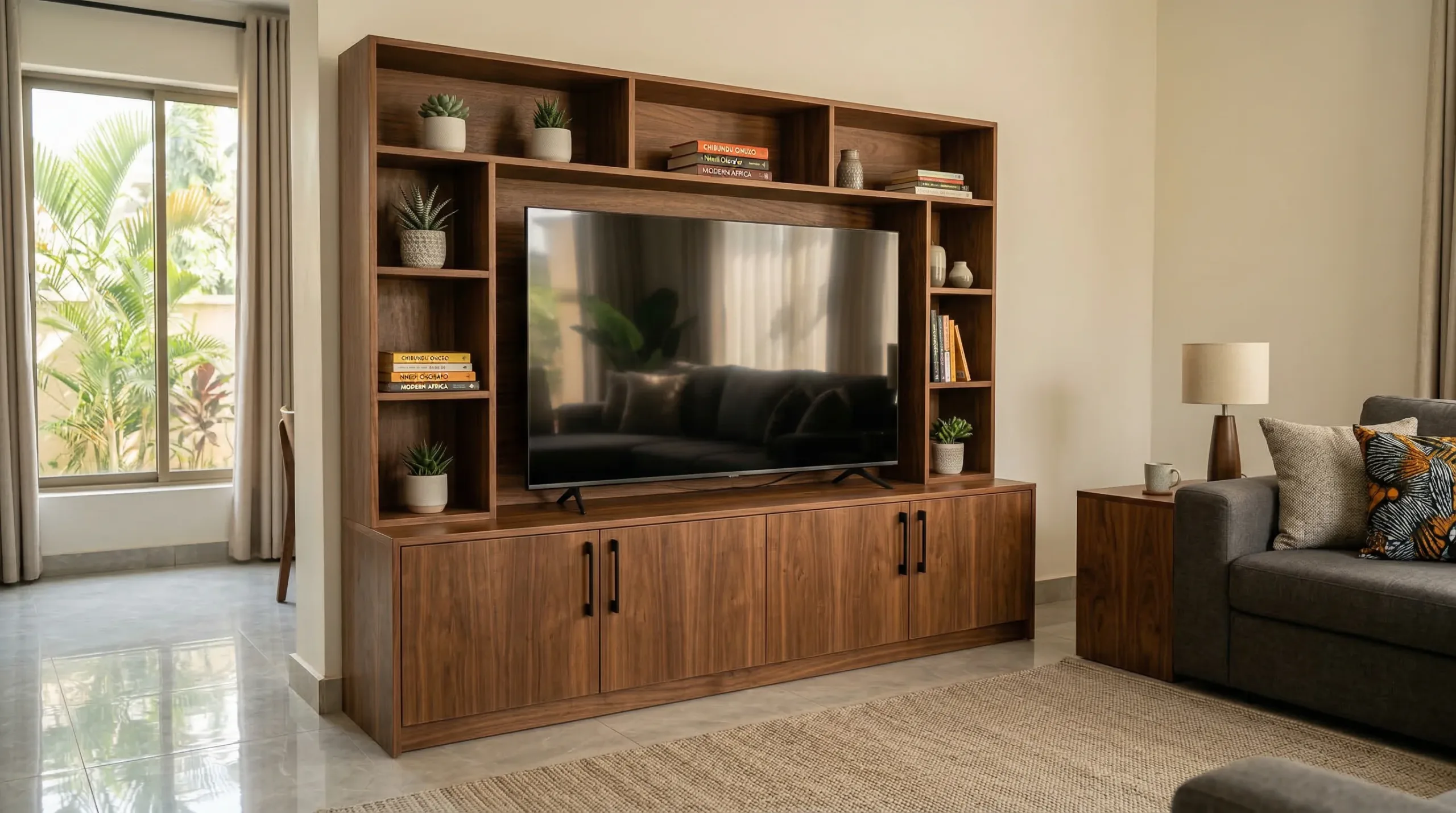
A TV stand in Nigeria costs between ₦6,000 and ₦7,400,000, and the figure that matters to you depends almost entirely on your screen size and where you buy. A stand for a 32-inch television starts around ₦6,000 on Jumia and ₦120,000 from a furniture retailer. A console for a 55-inch screen runs ₦150,000 to ₦900,000 across the market. A full wall unit for a 75-inch screen sits between ₦850,000 and ₦7,400,000. This page gives the current 2026 figures by screen size, compares what Jumia, Jiji, Fouani, Vava and Vento actually charge, and explains what separates a ₦40,000 stand from a ₦4,000,000 one.
Two things make Nigerian TV stand pricing confusing. The first is that the same words describe very different products — a “TV console” on Jiji at ₦95,000 and a “TV console” in a Lagos showroom at ₦1,800,000 are not the same class of furniture. The second is that prices are quoted for the piece alone, while the thing you actually need is a finished stand in your living room, delivered and assembled. This guide separates both.
How Much Does a TV Stand Cost in Nigeria? Prices by Screen Size
Screen size is the single strongest predictor of price, because the stand has to be wider than the television and every extra centimetre adds material, hardware and load-bearing structure. The table below is the practical answer: what each screen size needs, what the open market charges, and where Vento sits.
| TV size | Stand width needed | Marketplace (Jumia / Jiji) | Brand retail (Fouani / Vava) | Vento |
|---|---|---|---|---|
| 32″ | 110 – 130 cm | ₦6,000 – ₦55,000 | ₦120,000 – ₦180,000 | ₦520,170 |
| 43″ | 130 – 150 cm | ₦40,000 – ₦95,000 | ₦144,000 – ₦250,000 | ₦520,170 |
| 55″ | 150 – 175 cm | ₦95,000 – ₦210,000 | ₦150,000 – ₦480,000 | ₦520,170 – ₦850,170 |
| 65″ | 175 – 200 cm | ₦175,000 – ₦275,000 | ₦184,000 – ₦850,000 | ₦1,800,170 – ₦1,990,000 |
| 75″ | 200 – 230 cm | rarely stocked | ₦480,000 – ₦950,000 | ₦3,310,170 – ₦4,000,170 |
| 75″+ wall unit | 230 cm+ | not available | ₦850,000 – ₦1,200,000 | ₦6,000,170 – ₦7,400,000 |
Marketplace and brand-retail figures are live observations from Jumia, Jiji, competing showroom catalogues and Vento’s own current price list, checked September 2026. They move, particularly on the marketplace side where discounting is constant.
The width rule. The stand surface should be 4 to 10 inches wider than the television, measured corner to corner. A 65-inch TV is about 57 inches (145 cm) wide, so the console should be at least 155 cm and looks better at 165–175 cm. Buying a stand narrower than the screen is the most common sizing mistake in Nigerian living rooms — the piece looks top-heavy and the TV overhangs the cabinet edge.
TV Stand Prices by Screen Size — What Each Band Buys
32-inch and 43-inch TV Stands
These are bedroom, guest room, staff quarters and rental sizes. On Jumia a resizable floor stand starts around ₦6,000 and a basic MDF unit with a mount runs ₦40,000 to ₦55,000. Jiji used listings sit in the same band. At the furniture-retail end, Fouani’s Maxi range (120–136 cm) and Vava’s discounted stands cover ₦120,000 to ₦250,000.
Vento does not manufacture below ₦520,170, and for a 32-inch bedroom TV that is more stand than most rooms need. If the piece is functional rather than styled, a marketplace unit is the rational buy. Where Vento’s entry model earns its price at this size is when the bedroom is furnished to match the rest of the house and the stand needs to sit next to quality wardrobe and bed pieces without looking out of place.
55-inch TV Stands
This is the volume size in Nigerian living rooms and the most competitive price band. Jiji hanging consoles run around ₦210,000, Jumia mid-range units ₦95,000 to ₦175,000, Vava’s discounted “luxury foreign” stands from ₦150,000, and Fouani’s Provincia line ₦144,000 to ₦184,000. Vento’s Lovisa at ₦520,170 and Soffice at ₦850,170 sit above all of them.
The honest question at 55 inches is how long the piece needs to last and whether the TV wall is a styled feature or a functional corner. A ₦150,000 stand will hold the television. Whether it still closes properly in year four is a different question, and that is the whole of the price gap — our TV console buying guide lists the four things to check before you pay.
65-inch TV Stands
At 65 inches the marketplace thins out quickly — most Jumia and Jiji stock is built for 55 inches and below, and anything wider is either a custom carpentry job or a brand-retail piece. Vava tops out around ₦850,000 for its widest discounted unit; Fouani’s 2.2-metre Provincia stands cover this size at ₦144,000 to ₦184,000 when in stock, though much of that range shows as sold out.
Vento’s Rolex at ₦1,800,170 and Zelve at ₦1,990,000 are the two most-requested pieces at this size in our Lagos showroom. Both are 1.6–2.2 metres wide with combined open display and closed cabinet storage, and both have integrated cable channels — the detail that stops a 65-inch setup with a sound bar, decoder and games console from looking like a cable nest.
75-inch Screens and Full Wall Units
Above 65 inches the market splits cleanly. Marketplace stock effectively ends. Local carpenters will build to size, typically ₦400,000 to ₦900,000 for a wall-width unit in MDF with a laminate finish, on a four-to-eight week timeline. Brand retail runs ₦850,000 to ₦1,200,000 for imported units at this width.
Vento’s premium and luxury tiers — Armin at ₦3,310,170, Harmony at ₦4,000,170, San Marino at ₦6,000,170 and Valentino Ret at ₦7,400,000 — are full-wall installations with multi-compartment storage and finish grades intended to sit alongside a luxury collection sofa set. This is the tier where the entertainment unit is the room’s dominant feature rather than a place to put the TV.
Local vs Foreign TV Stands in Nigeria
This is the axis Nigerian buyers actually use, and it is not the same as cheap versus expensive. Both categories run across a wide price range, and each has a genuine case.
Locally made stands are built by Nigerian carpenters and small workshops, usually to order, usually in MDF or particleboard with a laminate or spray finish. Prices run ₦80,000 to ₦900,000 depending on width and finish. The advantages are real: you specify the exact width for your wall, you can match an existing finish, and there is no import cost in the price. The trade-offs are lead time (four to eight weeks is normal), variable finish quality between workshops, and no meaningful warranty — if a hinge fails in year two, you are back at the workshop, not making a claim.
Foreign or imported stands arrive finished from a factory. Turkish, Chinese and European manufacturing all appear in the Nigerian market at very different quality grades, so “imported” alone tells you nothing about the piece. What it does mean is a consistent finish, factory hardware and, from a retailer that stands behind the product, a warranty. Vava explicitly names part of its range “luxury foreign” for exactly this reason — the word carries weight with Nigerian buyers.
Vento manufactures in Turkey and ships to our own showrooms, which puts our pieces in the imported category but without the trading-company markup that sits on much of the imported stock in the market. Our full range is in the TV stands collection, and every piece can be seen in person at one of our ten Nigerian showrooms before you commit.
TV Stand, Console, Panel, Shelf or Cabinet — Which Do You Actually Want?
Nigerian listings use these five words almost interchangeably, and the difference changes the price by a factor of ten. Getting the term right before you search saves a lot of wasted comparison.
TV stand. A simple open-shelf piece whose only job is holding the television. Narrow, one or two shallow shelves, little or no closed storage. Cheapest format, and the right answer for a bedroom or a rental.
TV console. A long, low cabinet with enclosed storage — doors, drawers or both — alongside the TV surface. Wider and deeper than a stand, with hardware specified for daily use. This is what most Nigerian households mean when they say “TV stand” in 2026, and where the bulk of Vento’s range sits.
TV console panel. A wall-mounted or wall-clad backing panel behind the television, usually in slatted wood, high-gloss board or stone-effect finish, often with an LED strip. Frequently sold as a separate item from the console below it, and increasingly the piece Nigerian buyers are actually searching for when they ask about “TV console panel” prices. Panel-plus-console installations run ₦350,000 to ₦2,500,000 in the Lagos market depending on wall width and finish.
TV shelf. A floating shelf or wall bracket carrying the TV and sometimes a decoder, with no floor contact. The lightest and cheapest wall solution at ₦25,000 to ₦150,000, and the format that has grown fastest in Lagos new-build apartments where floor space is tight.
Television cabinet or entertainment unit. A full-wall installation combining display shelving, closed cabinet banks and often integrated lighting. Two to three metres wide and designed to dominate the room. Everything above ₦850,000 in the market is effectively in this class.
Where does the decoder go? Almost every Nigerian TV setup includes a DSTV or GOtv decoder, and it is the item most often forgotten at the buying stage. A decoder needs ventilation and line of sight for the remote, which rules out a fully enclosed cabinet with solid doors. Look for an open centre compartment, a glass-fronted door or a rear cable cut-out with airflow. Standalone decoder shelves and brackets run ₦8,000 to ₦45,000 if the console you want has no suitable compartment.
What You Get at Each Vento Price Tier
Budget Compact — ₦520,170 to ₦900,000
Built for bedrooms, guest rooms, second sitting rooms and smaller flats. Under 1.4 metres wide, rated for 32-inch to 55-inch screens, with two to three drawers or compartments. The Lovisa at ₦520,170 is the entry point — two drawers, open centre display shelf, screens to 55 inches. The Soffice at ₦850,170 steps up with closed cabinet storage on both sides and a 65-inch weight rating.
Modern Mid-Range — ₦1,000,000 to ₦2,000,000
The most-requested band in our Lagos showroom. Pieces run 1.6 to 2.2 metres, handle screens to 70 inches, and combine open display with closed storage for decoder, sound bar, games console and router. The Rolex at ₦1,800,170 is the single most-requested piece in the Vento range — matte finish, integrated cable channels, surface width for a 70-inch screen plus a 120 cm sound bar. The Zelve at ₦1,990,000 is the warm-wood alternative.
Premium Consoles and Wall Units — ₦3,000,000 to ₦5,000,000
For dedicated living rooms where the TV wall is a styling feature. Open display sections, multiple closed compartments, and a finish grade — lacquer depth, edge detailing, hardware — noticeably above the mid-range. The Armin at ₦3,310,170 is an entertainment-unit layout with multi-compartment storage; the Harmony at ₦4,000,170 is our most popular premium wall unit, rated to 75 inches.
Luxury Entertainment Units — ₦5,000,000 and Above
Media rooms and large formal living rooms, two to three metres wide, custom storage layouts and premium hardware throughout. The San Marino at ₦6,000,170 and the Valentino Ret at ₦7,400,000 are the two pieces in this class. Both are specified to sit alongside luxury sofa and dining suites without looking outclassed.
What Actually Drives the Price
Six specifications account for almost all of the variation between one TV stand and another at the same width. They are worth knowing because they let you judge whether a quote is fair for what it is.
- Width and screen rating. Moving from a 1.2-metre compact to a 2.5-metre wall unit roughly triples the material content, and the load-bearing hardware scales with it.
- Storage configuration. Open shelving is cheapest. Drawers with runners cost more. Closed cabinets with soft-close hinges and internal shelving cost more again. A unit combining all three sits at the top of its width band.
- Finish grade. Melamine and standard laminate are entry level. High-gloss lacquer, veneer over solid substrate and hand-applied detailing move a piece into premium. Finish alone can shift a mid-range console by ₦400,000 to ₦700,000.
- Hardware. Soft-close hinges, full-extension ball-bearing runners, integrated cable ports and concealed pulls add cost on every drawer and door. This is where cheap units fail first.
- Manufacturing origin. Local workshop, Turkish factory, Chinese import and European import are four different cost structures at four different quality grades. “Imported” on its own tells you nothing.
- What the price includes. Delivery, assembly and warranty are bundled by some retailers and charged separately or not offered at all by others. A ₦150,000 stand that needs ₦25,000 of transport and self-assembly is not a ₦150,000 stand.
Materials: Particleboard, MDF, Solid Wood, Glass and Veneer
Material specification is the strongest predictor of how long a TV stand survives Nigerian humidity, and it is what the price is mostly buying.
Particleboard (₦6,000 – ₦150,000). Compressed wood chips with a thin paper laminate face. Lightest and cheapest, dominant in marketplace listings. Swells with moisture and typically gives two to four years before hinges and surfaces start to fail.
MDF (₦150,000 – ₦500,000). Denser, takes finishes better, more dimensionally stable. The standard for mid-range marketplace and brand-retail consoles. Five to eight years with reasonable handling.
Glass and metal (₦45,000 – ₦300,000). Tempered glass shelves on a steel or aluminium frame. Light, easy to clean, visually unobtrusive, and popular for smaller screens. The limits are load rating and edge safety in homes with young children — check the stated screen weight rather than assuming.
MDF with a solid wood frame (₦500,000 – ₦2,000,000). Solid timber for legs, top rails and internal supports; MDF panels for sides and back. Standard Vento construction across the Budget Compact and Modern Mid-Range tiers, and the same build we use across the sofa sets range. Ten years plus of typical service.
Veneer over solid substrate (₦2,000,000+). Real hardwood slice bonded to a solid or high-density core. The finish grade in Vento’s premium and luxury tiers — looks and ages like solid hardwood at a fraction of the weight.
Reading Nigerian listings. “Wooden TV stand” on Jiji or Jumia nearly always means MDF or particleboard with a wood-look laminate. Genuine solid hardwood starts around ₦800,000; anything materially cheaper describing itself as solid wood is engineered board with a wood finish.
Where to Buy: Marketplace, Brand Retail or Showroom
Jumia and Jiji are where the cheapest stock lives — ₦6,000 to ₦275,000 covers almost everything listed. You get choice and speed, and on Jiji you can often negotiate. What you do not get is a warranty, consistent quality between listings, or any recourse if the piece arrives damaged. Best for rentals, second homes, bedroom sets and any situation where the stand is functional rather than styled.
Fouani and Vava occupy the brand-retail middle. Fouani’s Provincia and Maxi lines run ₦144,000 to ₦250,000 in widths from 1.2 to 2.26 metres, though a large share of the catalogue shows as sold out at any given time. Vava carries 18 TV stand lines across 17 showrooms at ₦150,000 to ₦850,000, discounted heavily from list. Both are genuine options if your budget stops below ₦900,000 and you want a finished factory piece rather than a marketplace unit.
Showroom furniture retailers including Vento sit above that. The case for the step up is not the stand in isolation — it is coordination with the rest of the room, finish grades that hold up next to quality sofa and dining pieces, delivery and assembly included, and a warranty you can actually claim against. If your living room is furnished at that level, a ₦180,000 stand will look under-specified next to it. If it is not, it will not.
Whichever route you take, see the piece in person if you can. Finish quality and drawer action are the two things photographs consistently misrepresent, and both are what you will notice every day. Our TV console buying guide covers what to check on the showroom floor, and the TV console designs guide covers styles if you have settled the budget and are choosing on looks.
Alternatives to a Dedicated TV Console
Three alternatives work well in Nigerian living rooms, each trading something for a lower price or a lighter visual footprint.
- Sideboard or credenza (₦400,000 – ₦1,800,000). A dining-room piece used in the living room. Taller than a TV console at 75–90 cm, deeper storage, more formal. Works when the TV is wall-mounted and the cabinet is playing a styling role. Our centre tables and complementary pieces pair with this approach.
- Console table (₦200,000 – ₦600,000). Narrow, long, open legs, no enclosed storage, placed below a wall-mounted TV. Cheapest format and the smallest visual footprint. Best where storage is handled elsewhere.
- Floating wall-mounted unit (₦150,000 – ₦800,000). Bracketed to the wall with no floor contact. Frees the floor visually and is easier to clean around, but limited in storage and load capacity. Check the wall structure takes the bracket load before committing, and keep the screen at 65 inches or below.
Delivery, assembly and instalments. Vento pricing includes free Lagos delivery at every tier, with Abuja and Port Harcourt quoted separately at order stage. Assembly is included in all three cities. Instalment plans are available across all four tiers; terms depend on the piece and the deposit, and a quote request returns the exact monthly figure.
Browse all TV stands Request a quote
TV Stand & TV Console Price FAQ (Nigeria)
How much does a TV stand cost in Nigeria?
TV stands in Nigeria cost from ₦6,000 to ₦7,400,000. Marketplace stands on Jumia and Jiji run ₦6,000 to ₦275,000. Brand retailers such as Fouani and Vava charge ₦144,000 to ₦950,000. Showroom furniture retailers including Vento start at ₦520,170 and run to ₦7,400,000 for full-wall entertainment units. Most Nigerian households buying a finished, delivered piece spend between ₦150,000 and ₦900,000.
How much is a TV stand for a 43-inch TV in Nigeria?
A stand for a 43-inch TV costs ₦40,000 to ₦250,000 in Nigeria. The stand should be 130–150 cm wide. Jumia and Jiji cover ₦40,000 to ₦95,000 in MDF or particleboard; Fouani’s Maxi and Provincia lines and Vava’s discounted range cover ₦144,000 to ₦250,000 in factory-finished board. Vento’s entry model, the Lovisa at ₦520,170, is above this band and aimed at rooms furnished to a matching standard.
How much is a TV stand for a 55-inch or 65-inch TV?
For a 55-inch TV expect ₦95,000 to ₦480,000 across the market, with a stand width of 150–175 cm. For a 65-inch TV expect ₦175,000 to ₦850,000, with a width of 175–200 cm. At Vento the 55-inch band is covered by the Lovisa (₦520,170) and Soffice (₦850,170), and the 65-inch band by the Rolex (₦1,800,170) and Zelve (₦1,990,000), which add integrated cable management and closed storage.
What is the cheapest TV stand in Nigeria?
The cheapest TV stands in Nigeria are Jumia resizable floor stands from about ₦6,000, followed by basic MDF units at ₦40,000 to ₦55,000. Used listings on Jiji start around ₦25,000. These are particleboard or light MDF with no warranty, no assembly and no included delivery, and typically give two to four years of service. The cheapest factory-finished showroom piece at Vento is the Lovisa TV Stand at ₦520,170.
What is the difference between a TV stand, a TV console and a TV console panel?
A TV stand is a simple open-shelf piece that only holds the television. A TV console is a long, low cabinet with enclosed storage — doors, drawers or both — alongside the TV surface. A TV console panel is the wall-mounted backing panel behind the television, usually slatted wood, high-gloss board or stone-effect finish and often with LED lighting, sold separately from the console beneath it. Panel-plus-console installations run ₦350,000 to ₦2,500,000 in Lagos.
Is a local or foreign TV stand better value in Nigeria?
Locally made stands cost ₦80,000 to ₦900,000, can be built to your exact wall width and carry no import cost, but take four to eight weeks and rarely come with a warranty. Imported stands arrive factory-finished with consistent quality and, from a showroom retailer, a warranty you can claim against. Neither is automatically better value — local wins on fit and price, imported wins on finish consistency and recourse if something fails.
How much is a TV shelf or floating TV unit in Nigeria?
A wall-mounted TV shelf costs ₦25,000 to ₦150,000 in Nigeria, and a floating wall-mounted cabinet with enclosed storage runs ₦150,000 to ₦800,000. Both free up floor space and suit Lagos new-build apartments where the room is tight. The limits are storage capacity and load rating — confirm the wall structure takes the bracket load and keep the screen at 65 inches or below.
Where does the decoder go in a TV console?
A DSTV or GOtv decoder needs ventilation and line of sight for the remote, so it cannot sit in a fully enclosed cabinet with solid doors. Look for an open centre compartment, a glass-fronted door, or a rear cable cut-out with airflow. If the console you want has no suitable compartment, standalone decoder shelves and brackets cost ₦8,000 to ₦45,000.
Why are showroom TV consoles more expensive than Jumia or Jiji prices?
Marketplace stands are typically particleboard or basic MDF with no warranty, no assembly and no included delivery, giving two to four years of service. Showroom pieces from retailers like Vento are factory-finished with solid wood frame construction, multi-year warranty, and delivery and assembly included in Lagos, Abuja and Port Harcourt. The gap reflects different material and service specifications rather than different margins on the same product.
Do TV stand prices in Nigeria change with the exchange rate?
Imported TV stand prices move with the naira, because the manufacturing and shipping costs are in foreign currency. Vento prices are set in naira and held for a full quarter, then reviewed and adjusted only if the rate has moved materially. Locally made stands are less exposed to the rate but still track imported board, hardware and finish costs. Marketplace prices move most often, sometimes weekly.