
Blog
Mattress Prices in Nigeria: Sizes, Brands & Costs (2026)
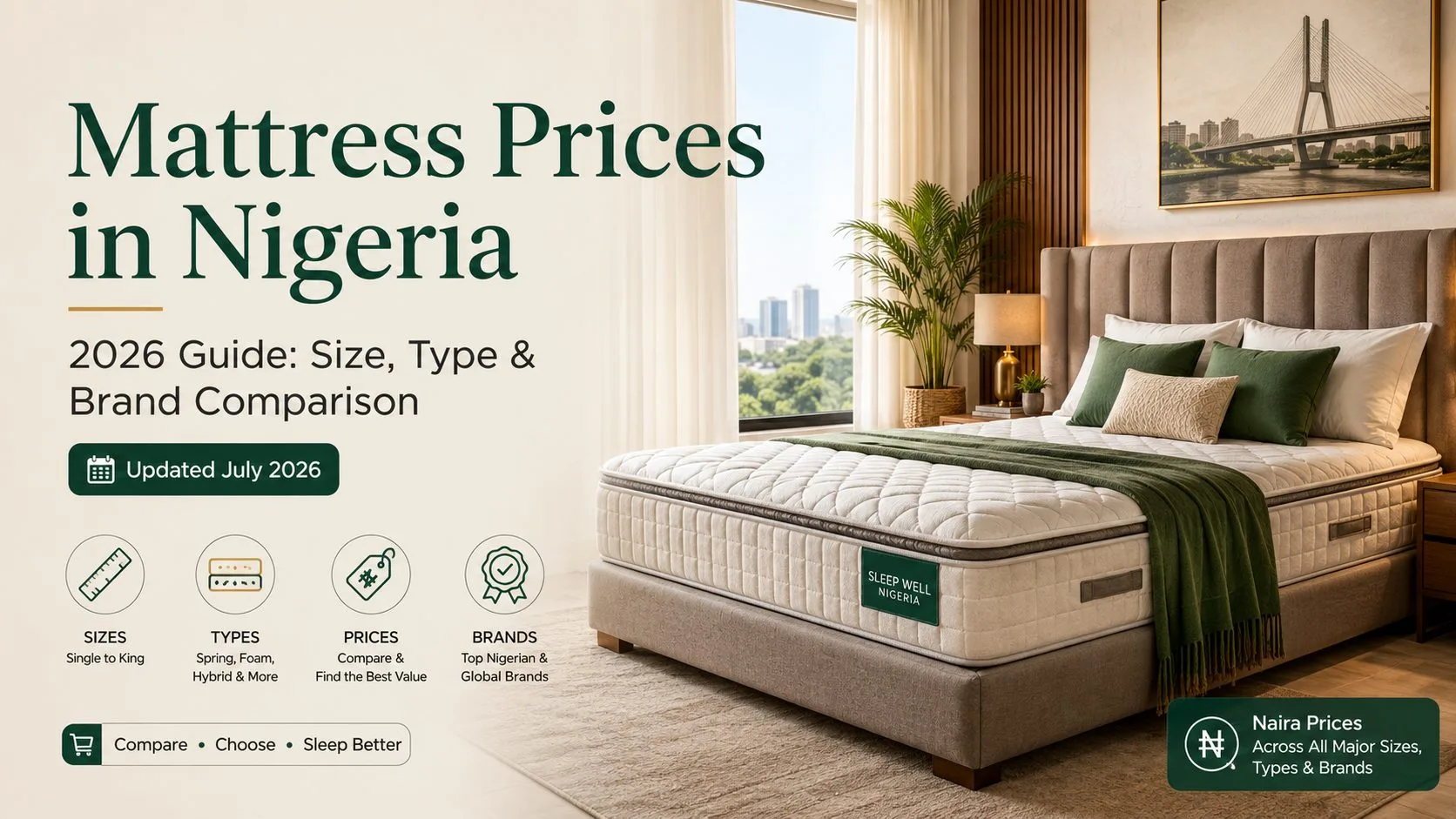
Mattress prices in Nigeria run from about ₦25,000 for a small budget foam to ₦500,000 and above for a large full-orthopedic or spring mattress. A standard 6 by 6 semi-orthopedic mattress — the size most Nigerian couples buy — typically lands between ₦120,000 and ₦250,000 depending on brand and thickness. Price is driven by four things: size, thickness, foam density and whether the mattress is standard foam, semi-orthopedic, full orthopedic or spring.
The confusing part is that two mattresses of the same size can differ by ₦200,000, and the label on the plastic wrap rarely explains why. This guide breaks the price down by size, by type and by brand, then shows you how to match the mattress to the bed frame you already own — the step most buyers skip and regret.
Quick take: Budget ₦25,000–₦60,000 for a basic foam, ₦120,000–₦250,000 for a 6 by 6 semi-orthopedic, and ₦250,000–₦500,000+ for full orthopedic or spring. Buy by density and thickness rather than brand name, measure your bed frame before you pay, and always buy from an authorised dealer — counterfeit foam is common in Nigerian markets.
What actually determines a mattress price in Nigeria
Four variables account for almost the entire price range. Understanding them lets you read any price tag and know whether it is fair, and it stops you paying orthopedic money for a standard foam in a thicker cover.
Size
Nigerian mattresses are sold in feet — 3½ by 6, 4 by 6, 4½ by 6, 5 by 6, 6 by 6, 6 by 7 and 7 by 7. Size is the single biggest price lever because you are paying for volume of foam. Moving from a 4 by 6 to a 6 by 6 in the same model usually adds 60–90% to the price, not 50%, because the larger sizes are produced in smaller runs.
Thickness and density
Thickness is measured in inches — commonly 6, 8, 10 or 12. Density, expressed in kg/m³, is what actually decides how long the mattress lasts and how much weight it carries. A thick, low-density mattress feels generous in the showroom and collapses within two years. Density is the number to ask for, and it is the one most sellers will not volunteer.
Type: foam, semi-orthopedic, orthopedic or spring
Standard foam is the entry point. Semi-orthopedic adds firmness and density for back support at a moderate premium. Full orthopedic uses the highest densities and firmest build for spinal alignment. Spring and memory-foam mattresses sit at the top of the market and can pass ₦500,000 in the larger sizes.
Brand, warranty and where you buy
Established brands — Mouka, Vitafoam, Winco Foam — charge more, and part of that premium is a real warranty and a traceable dealer network. Market traders sell cheaper, but a mattress is exactly the product where counterfeits are common, because the difference is hidden inside a sealed cover.
Mattress sizes in Nigeria and what they cost
The table below maps every common Nigerian mattress size to its dimensions, who it suits, and the price band you should expect as of July 2026. Bands are wide on purpose: the same size swings enormously between a 6-inch standard foam and a 12-inch full orthopedic.
| Size (ft) | Approx. cm | Best for | Typical price band (₦) |
|---|---|---|---|
| 3 by 6 | 90 × 180 | Children, single beds, staff quarters | 25,000 – 70,000 |
| 3½ by 6 | 105 × 180 | Teenagers, small single rooms | 35,000 – 90,000 |
| 4 by 6 | 120 × 180 | Single adult, guest room | 45,000 – 130,000 |
| 4½ by 6 | 135 × 180 | Small double, self-contained flats | 60,000 – 160,000 |
| 5 by 6 | 150 × 180 | Standard double / queen | 85,000 – 200,000 |
| 6 by 6 | 180 × 180 | Couples, master bedroom (most popular) | 120,000 – 300,000 |
| 6 by 7 | 180 × 210 | Taller sleepers, king-size frames | 160,000 – 380,000 |
| 7 by 7 | 210 × 210 | Super king, large master suites | 200,000 – 550,000 |
Two notes on reading this table. First, the lower end of each band is standard foam at 6 inches; the upper end is orthopedic or spring at 10–12 inches. Second, prices in Lagos and Abuja tend to sit above the national average because of showroom and logistics costs — if you are furnishing a whole home, our guide on how to furnish a home in Nigeria shows where that budget is best spent.
Mattress prices by type
Once you have fixed the size, type is the next decision, and it is where most of the remaining money goes.
Standard foam mattresses
These are the everyday mattresses that fill most Nigerian homes — typically 6 to 8 inches, medium density, no orthopedic claim. In a 4 by 6 they generally sit between ₦45,000 and ₦90,000. Entry-level models from smaller manufacturers start lower still, but below roughly ₦25,000 for a full-size mattress you are almost always buying low-density foam that will dip within a year or two.
Semi-orthopedic mattresses
Semi-orthopedic is the sweet spot for most buyers, and it is the class most commonly sold in Nigeria. It uses higher-density foam and a firmer feel than standard foam without the price of full orthopedic. A 6 by 6 semi-orthopedic typically runs ₦120,000 to ₦250,000; classified listings frequently show them around ₦140,000. If you have occasional back stiffness rather than a diagnosed condition, this is usually the right tier.
Full orthopedic mattresses
Full orthopedic mattresses use the highest densities and the firmest construction, aimed at spinal alignment and heavier sleepers. Manufacturer pricing puts orthopedic lines well above the classic ranges — Vitafoam’s orthopedic models start around ₦206,000, and large-size orthopedic mattresses in the open market are commonly listed near ₦370,000. Expect ₦250,000 to ₦500,000 for a 6 by 6 or larger in this class.
Spring and memory foam
Spring mattresses pair a coil core with foam layers and sit at the premium end — large sizes are regularly listed above ₦500,000. Memory foam is still a small segment in Nigeria and is mostly sold by specialist retailers rather than the big foam houses. Both are worth considering only after you are certain the bed frame can carry the extra weight.
Mattress prices by brand
Brand pricing is more consistent than market pricing, and the major manufacturers publish figures you can check before you shop.
Mouka
Mouka’s range starts very low and climbs steeply. Entry models such as Comfy begin around ₦13,000 in the smallest sizes, Koko and the kiddies range sit near ₦21,000–₦22,000, and the Legend line starts around ₦80,000. Semi-orthopedic and orthopedic models climb from there, and large orthopedic builds can approach ₦500,000.
Vitafoam
Vitafoam’s published starting prices run from about ₦33,000 for Vita Corona, ₦86,000 for Vita Grand, ₦168,000 for Vita Galaxy Classic and ₦206,000 for Vita Galaxy Orthopedic. As a rule of thumb, Vitafoam’s orthopedic tier costs roughly two to three times its entry tier in the same size.
Winco Foam
Winco has built its position on orthopedic and back-support lines and is one of the three brands most often named when Nigerians discuss mattress quality. Its pricing broadly tracks Vitafoam’s orthopedic tier.
Smaller and regional brands
Mainfoam, Sarafoam, ENO Foam and Elite Foam compete below the big three, with budget lines commonly quoted in the ₦22,000–₦60,000 range. They can be good value, but warranty terms and dealer coverage vary, so check both before you commit.
How to choose the right mattress for your body
Price tells you what a mattress costs; these three factors tell you whether it is the right one. Getting this wrong is more expensive than overpaying, because a mismatched mattress gets replaced early.
Match density to body weight
- Under 50 kg — a medium-density 6 to 8 inch mattress is usually enough; very firm builds will feel hard rather than supportive.
- 50 to 90 kg — the standard case. A medium-firm 8-inch mattress in semi-orthopedic gives the best balance of comfort and lifespan.
- Above 90 kg — go to at least 10 inches and high density. Thickness without density will sag; this is the most common and most expensive mistake.
- Two sleepers with a large weight gap — size up on density rather than splitting the difference, or the heavier sleeper creates a permanent dip.
Match firmness to sleeping position
Side sleepers need enough give at the shoulder and hip to keep the spine straight, so a medium feel usually suits them better than a hard orthopedic slab. Back sleepers do well on medium-firm. Front sleepers need the firmest option available, because a soft mattress lets the hips sink and arches the lower back.
If you have back pain
Back pain points toward full orthopedic or a high-density semi-orthopedic — the goal is keeping the spine straight rather than maximum hardness. A mattress that is too firm for your weight is as bad as one that is too soft. If pain is persistent, treat the mattress as one part of the fix, not the whole of it.
Matching your mattress to the bed frame
This is the step almost every mattress guide skips, and it is where Nigerian buyers lose the most money. A mattress bought without measuring the frame either overhangs, leaves a gap that swallows pillows, or sits so high that the bed becomes awkward to get into.
Get the three measurements that matter
- Internal frame length and width — measure inside the rails, not the outer edge of the bed. A “6 by 6” frame is not always exactly 180 cm internally.
- Slat or base type — solid platforms suit foam mattresses; widely spaced slats can shorten a foam mattress’s life and may void a warranty.
- Headboard clearance and total height — a 12-inch orthopedic mattress on a tall frame can leave the headboard visually swallowed and the mattress edge above it.
Common sizing mistakes
The most frequent error is assuming that a bed sold as “king size” takes a 7 by 7 mattress. Nigerian frame sizing varies by maker, and a 6 by 7 is often the correct fit. Our guide to king size bed designs in Nigeria sets out the frame dimensions you will actually encounter, and the bed frame prices in Nigeria guide covers what the frame itself should cost.
If you are buying both at once, matching them as a set is simpler and usually cheaper than sourcing separately — our bedroom set designs guide walks through the combinations that work in Nigerian room sizes. For children’s rooms, frame choice constrains mattress thickness more than adults expect; see bunk bed designs in Nigeria before buying a thick mattress for an upper bunk.
Where to buy, and how to avoid counterfeits
Mattresses are a favourite target for counterfeiters because the difference is sealed inside a cover you cannot inspect. Buy from an authorised dealer, a brand showroom or an established retailer rather than an unknown roadside seller, and treat a price far below the brand’s published range as a warning rather than a bargain.
Before you pay, check that the manufacturer’s label is intact and machine-stitched rather than glued on, ask for the density figure and the warranty period in writing, and confirm the return policy — a mattress that has been slept on is rarely returnable, so the inspection has to happen before delivery. If you are shopping in person, our guides to furniture stores in Lagos and furniture stores in Abuja list the established showroom clusters in both cities.
Making a mattress last in Nigeria’s climate
Heat and humidity shorten mattress life here faster than in temperate climates, and most of the damage is preventable.
Ventilation and rotation
Foam holds moisture. Air the room daily, avoid pushing the bed flat against an exterior wall that sweats in the rainy season, and rotate the mattress head-to-foot every three months so the same area is not always loaded. A breathable protector helps; a plastic cover left on permanently does the opposite, trapping moisture inside the foam.
When to replace it
A quality mattress should give six to eight years. Replace it earlier if you can see a visible dip where you sleep, if you wake with stiffness that eases during the day, or if the edges have lost their shape and no longer support you sitting down. A sagging mattress on a good frame is worth replacing before the frame is, not after.
Frequently asked questions
How much is a mattress in Nigeria?
Mattress prices in Nigeria range from about ₦25,000 for a small basic foam to over ₦500,000 for a large orthopedic or spring mattress. The most common purchase — a 6 by 6 semi-orthopedic — typically costs ₦120,000 to ₦250,000. Size, thickness, foam density and type account for almost all of the difference.
How much is a 6 by 6 mattress in Nigeria?
A 6 by 6 mattress generally costs between ₦120,000 and ₦300,000. Standard foam at 6 to 8 inches sits at the lower end, semi-orthopedic around ₦140,000 to ₦250,000, and full orthopedic or spring models at the top. Thickness and density move the price more than the brand name does.
How much is a 4 by 6 mattress in Nigeria?
A 4 by 6 mattress typically costs ₦45,000 to ₦130,000. Basic foam models start around ₦45,000, while semi-orthopedic and orthopedic versions in the same size run considerably higher. This is the usual size for a single adult bed or a guest room.
How much is a 7 by 7 mattress in Nigeria?
A 7 by 7 mattress usually costs ₦200,000 to ₦550,000. It is the largest common Nigerian size and is produced in smaller volumes, so the price premium over a 6 by 6 is steeper than the extra surface area alone would suggest. Confirm your frame takes 7 by 7 before ordering.
Is Vitafoam better than Mouka?
Neither brand is uniformly better — both are established Nigerian manufacturers with entry, semi-orthopedic and orthopedic tiers. Compare like for like: the density, thickness and warranty of the specific model, not the brand. A high-density Mouka will outlast a low-density Vitafoam and the reverse is equally true.
What is the best mattress brand in Nigeria?
Mouka, Vitafoam and Winco Foam are the three most widely trusted mattress brands in Nigeria, with Mainfoam and Sarafoam competing below them. All three majors offer orthopedic lines and dealer warranties. The best choice depends on the density and thickness you need rather than the badge.
How much is Mouka foam 6 by 4?
A Mouka mattress in 4 by 6 typically falls between ₦45,000 and ₦130,000 depending on the series and thickness. Entry lines such as Comfy and Koko sit at the lower end, while Regina and orthopedic models cost substantially more in the same size.
What is the difference between orthopedic and semi-orthopedic mattresses?
A full orthopedic mattress uses the highest foam density and firmest construction for spinal alignment, while a semi-orthopedic sits between standard foam and full orthopedic — firmer and denser than everyday foam but softer and cheaper than full orthopedic. Semi-orthopedic suits most Nigerian households; full orthopedic suits heavier sleepers and diagnosed back problems.
What mattress size fits my bed frame?
Measure the inside of the frame rails rather than trusting the label, because Nigerian frame sizing varies by maker. A bed described as king size often takes a 6 by 7 rather than a 7 by 7. Also check the base type — solid platforms suit foam mattresses better than widely spaced slats.
What mattress should you avoid in Nigeria?
Avoid thick mattresses sold at unusually low prices, because thickness without density sags within months. Also avoid unlabelled mattresses, sellers who will not state the density or warranty, and any mattress priced far below the manufacturer’s published range — counterfeits are common and the difference is hidden inside the cover.
Prices in this guide reflect manufacturer and market listings as of July 2026 and are indicative bands, not quotations. Confirm current pricing with the dealer before you buy.
Once the mattress is settled, the frame and the rest of the room are the next decision. Browse Vento’s bedroom sets to see frame sizes, storage options and finishes that work with the mattress size you have chosen.